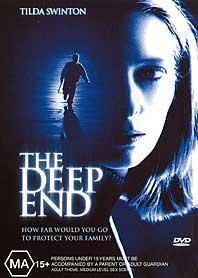
If you’ve been a fan of the thriller genre for any length of time, you’ll probably have started wondering just when the word “thriller” became so inappropriate. Movie after movie comes along promising you to “keep you on the edge of your seat” and “leave you breathless” only to turn out to be a slickly-made but utterly brainless piece of generic storytelling that operates to a strict formula. Each thriller must have a villain, a victim, and a valiant soul who intervenes at a crucial moment and then promptly gets killed in a nasty way. There’s always a twist, and if it’s a high-profile thriller there’s probably two or three of them. A lot of things go “boo!” to try and scare you, the sound mixer knowing he’s got a hundred decibels of dynamic range and taking full advantage of every last one. The victim starts the film afraid and ends it triumphant (and usually in serious need of a shower). And so on, and so on. The sheer predictability of American thrillers is enough to drive you screaming into the arms of Merchant-Ivory.
But look, we always whinge about Hollywood over here. And that’s not always fair, because every so often the land of all things glitz will throw some cash at an independent filmmaker or two and let them have their wicked way with some actual resources. To the studio it’s a no-brainer - the film gets made for a piddlingly tiny amount of money that wouldn’t even pay for the logo design on Spider-Man, the studio gets to put it out under their “quality” sub-label (every big studio has one) and look like they’re champions of true art, and the filmmakers get to, err, make their film. Everybody wins.
And with The Deep End, thriller fans win as well. Because this is one of those rare occasions where a thriller is actually surprising, non-hysterical, compelling and… well, thrilling (but not in a behind-you-behind-you kind of way). It’s the work of writing-producing-directing duo Scott McGehee and David Siegel, who impressed the hell out of just about everyone who saw their debut Suture. It’s taken them nearly a decade to make another film, but the wait was well worthwhile; The Deep End, with its bubbling undercurrent of pure menace underpinning some great performances, is one of the most intelligent psychological thrillers in years. If it happens to seem a bit old-fashioned in its execution, that’s probably by design; it’s based on a novel called The Blank Wall by Elisabeth Holding, which was also the basis for the 1942 James Mason film The Reckless Moment. Which means that The Deep End, ironically, is a remake, which must have been comforting to a retro-happy Hollywood.
Margaret Hall (British actor Tilda Swinton, who was hugely impressive in Orlando) is a hard-working mother living in the picturesque Lake Tahoe region of Nevada, who’s had to take on the role of sole parent while her husband is away on a tour of duty in the US Navy. Already concerned for her son Beau (Jonathan Tucker, who will be familiar to fans of TV show The Practice from his memorable guest role there) after he was involved in a car accident with a man he’s been seeing, she is horrified to find that man, Darby Reese (Josh Lucas) dead in the water (literally!) after an argument with her son the night before. Immediately clicking into protective-mother mode, she goes to great lengths to shield her son from any danger or recriminations. But in doing so, she opens a door of opportunity for some people who are not very nice at all… or are they?
The story is simple; the inner workings of it are not. But in more mainstream hands, this could have turned into another carriage on the Big Long Goods Train Of Predictable Thrillers. Instead, thanks to a sensible script that never bothers with hyperbole when subtlety works better - and some inspired direction - The Deep End unfolds its story with a gentle precision that’s quite wonderful. And at the centre of it all is Tilda Swinton; always a commanding actor, she’s got the entire movie resting on her here as the emotional heart of it all, and she pulls it off flawlessly - American accent and all.
Despite a couple of glaring plot holes, The Deep End is a terrifically subtle thriller that eschews the star-power-and-big-audio working method for something a bit more intelligent. Extremely well made and loaded with great scenes, it’s the most European-like American studio picture you’re likely to see this year.
Shot with anamorphic lenses and never afraid to use the wide frame to its best advantage, The Deep End should only be watched in its original 2.35:1 aspect ratio. Presented here as the directors intended, the film scores a magnificent transfer from Fox, a company that’s become extremely reliable in the quality department with their DVD transfers of late. The 16:9 enhanced image is richly detailed and perfectly balanced. Deliberately colour-balanced to create a very muted, slightly desaturated look on screen, the image is faithfully transferred to video with its sometimes delicate shadow detail intact. Aside from some edge enhancement that’s occasionally a bit too noticeable, this is a wonderful video transfer.
There are no compression problems of any kind visible, which is especially commendable given that the entire film is stored on a single layered disc with space to spare.
The movie’s theatrical Dolby Digital 5.1 audio track is the only choice on this rental disc, and a wonderfully involving and immersive sound mix it is. Loaded with detail and making full use of the surround sound stage, the audio here is unusually active for what is essentially a dialogue-driven movie. That dialogue is anchored to the centre while various effects constantly move across the front channels, and the surrounds play a vital role in building location atmosphere and realism, particularly in outdoor scenes (love those surround crickets!) and as an integral part of the full-surround music score. Those wishing to show off their big obnoxious subwoofer should look elsewhere, as the LFE channel is barely used here (and quite rightly too - there’s nothing here that justifies its use anyway).